VMS vs ITMS: How Video Management and Intelligent Traffic Systems Support Modern Security
Ask a city police department and its traffic wing who owns the camera at a busy junction, and a few years ago you'd have got two answers. Sometimes three. Now the same camera might help trace a stolen bike at 9 p.m. and catch a signal jumper five minutes later. Because of that overlap, the people running security and city operations have stopped treating video systems and traffic systems as two unrelated purchases.
They still aren't the same thing. I've watched projects drift because someone assumed a traffic platform would cover general surveillance, or that an ordinary video setup could raise challans by itself. Worth being clear, then, about what each one actually does.
What a Video Management System Actually Does
A Video Management System (VMS) is the control desk for your cameras. It connects to them, puts the live view on screen, records everything, and helps you get back to a specific moment when you need it. That's the core job. On a normal day, nobody notices it running.
You notice it when something goes wrong. Say there's a break-in at the back gate of a college campus. The security head has no interest in scrolling through six hours of video from twelve cameras. They want the right camera, the right time window, and a clean clip to hand over to the police. A decent VMS turns that into a ten-minute job rather than an all-night one.
What you'll use most
The practical features stay much the same from site to site. ONVIF support lets you mix camera brands, which matters when a place has been adding cameras bit by bit for ten years. Role-based access sets who can watch, who can download footage and who can change settings. Multi-site control lets one team keep an eye on branches in different cities from a single place.
Then there's AI analytics. Rather than depending on an operator to notice someone climbing a fence at 3 a.m., the system flags intrusion, loitering or entry into restricted areas and pushes an alert. This is where most security teams feel the biggest change. People get tired staring at screens. Software doesn't.
What an Intelligent Traffic Management System Actually Does
An Intelligent Traffic Management System (ITMS) is built for one environment: the road. It uses AI, IoT devices and video analytics, all tuned to read vehicles, lanes, speed and traffic rules. A general camera sees a street. An ITMS sees a bike with three riders and no helmet heading the wrong way down a one-way lane.
The enforcement side is the part most people know. It picks up speeding, helmetless riding, triple riding, wrong-way driving and vehicles parked where they shouldn't be. Number plate recognition (ANPR or LPR) reads the plate, ties it to the violation, and the details can go straight into the e-challan process. That's how many Indian cities now send a fine to your phone with nobody waving you down.
The part people underrate
Enforcement is only half the story. Traffic teams also need to know when a junction is starting to choke, when there's been an accident on the flyover, or when a vehicle has broken down in the middle lane at peak hour. An ITMS catches congestion, incidents and accidents and raises an alert while there's still time to do something.
Over months, that flow data turns into good planning material. You stop guessing which signals need retiming and start working from what the roads are doing. The people using all this are usually traffic police, highway operators and smart city teams, and their questions look nothing like a security manager's.
Key Differences Between VMS and ITMS
In one line: a VMS helps you see and find, an ITMS helps you understand and act on what's happening on the road. The details break down like this.
Focus
A VMS doesn't care where it's installed. Hospital, warehouse, mall, city square, same job everywhere. An ITMS is specialised. Put it inside an office building and most of its intelligence has nothing to work with.
Data sources
A VMS mainly handles video from fixed and PTZ cameras. An ITMS uses video too, usually alongside ANPR cameras, speed detection and other roadside sensors. What comes out differs as well: structured records such as plate numbers, violation types and vehicle counts, not only footage.
Who uses it
Security managers and control room operators live inside a VMS. Traffic police, transport departments and highway teams live inside an ITMS. A smart city command centre may have both groups in one room, watching for completely different things.
What you get out of it
A VMS gives you awareness and evidence. An ITMS gives you enforcement, traffic insight and quicker response on the road. Swap one for the other and the results will disappoint you.
How the Two Systems Work Together
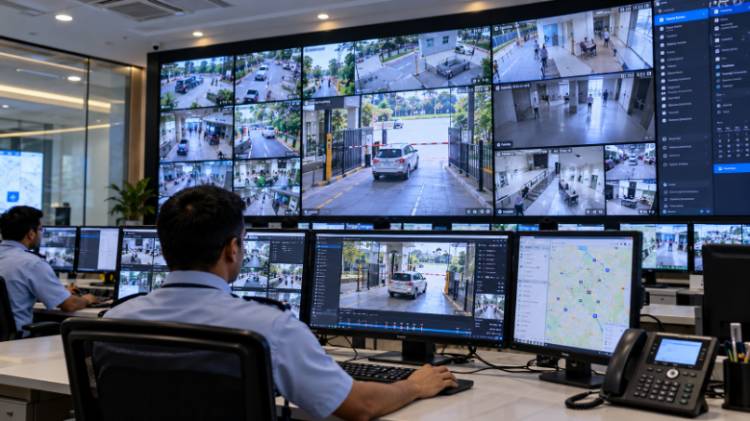
In most real deployments, the VMS is the backbone. It handles the camera feeds, keeps the recordings and gives operators one screen to work from. The ITMS runs its traffic analytics on those feeds or beside them.
Here's where it pays off. Picture a chain snatching near a crowded bus stand. The security team pulls the VMS footage and gets a look at the bike and its plate. They run that plate through the traffic system's ANPR records and see which junctions it crossed over the next fifteen minutes. What once meant phone calls to three departments and a day of waiting can come together inside an hour.
It works the other way round just as often. The ITMS detects a collision on a main road. An operator opens the nearest camera views in the VMS, sees how bad it is, and decides whether to send an ambulance, a tow truck or both, and where to divert traffic.
So integration belongs on your checklist from day one. A video management system built on open standards, with room for AI analytics, makes it far easier to add traffic modules later without ripping out cameras you've already paid for.

Practical Benefits for Security, Traffic and Smart City Teams
Security teams get context, and context is what turns footage into a lead. One clip of a suspect vehicle says very little. Its movement across the city over the following half hour says a lot.
Traffic authorities get stronger cases and fewer disputes. A challan that arrives with clear visual evidence tends to end the argument. An incident alert that can be checked on camera before anyone is dispatched saves crews from chasing false alarms. A properly set up intelligent traffic management system also hands planners numbers they can trust, instead of manual counts taken on one random Tuesday.
Smart city projects gain simpler infrastructure. Shared cameras, one command centre and connected data leave fewer disconnected systems to maintain and fewer gaps where nobody is watching. Adding something later, like crowd monitoring for a festival or traffic control around a metro construction zone, becomes much less painful.
Large campuses, industrial parks and gated townships see the same benefit on a smaller scale. Their gates, internal roads and parking areas behave like a small town, and they need both kinds of visibility.
Choosing and Integrating Without Regret
The mistake I run into most often is buying for the tender document instead of for the people who'll run the system every day. A city picks one vendor for enforcement and another for surveillance, then finds out a year later that the two won't share feeds without an expensive custom project. Ask how the systems will connect before you sign, not after.
Start with the questions your operators have to answer on an ordinary shift and work backwards. Cameras are rarely the hard part. Getting the right information to the right person while it still matters is what makes the difference.